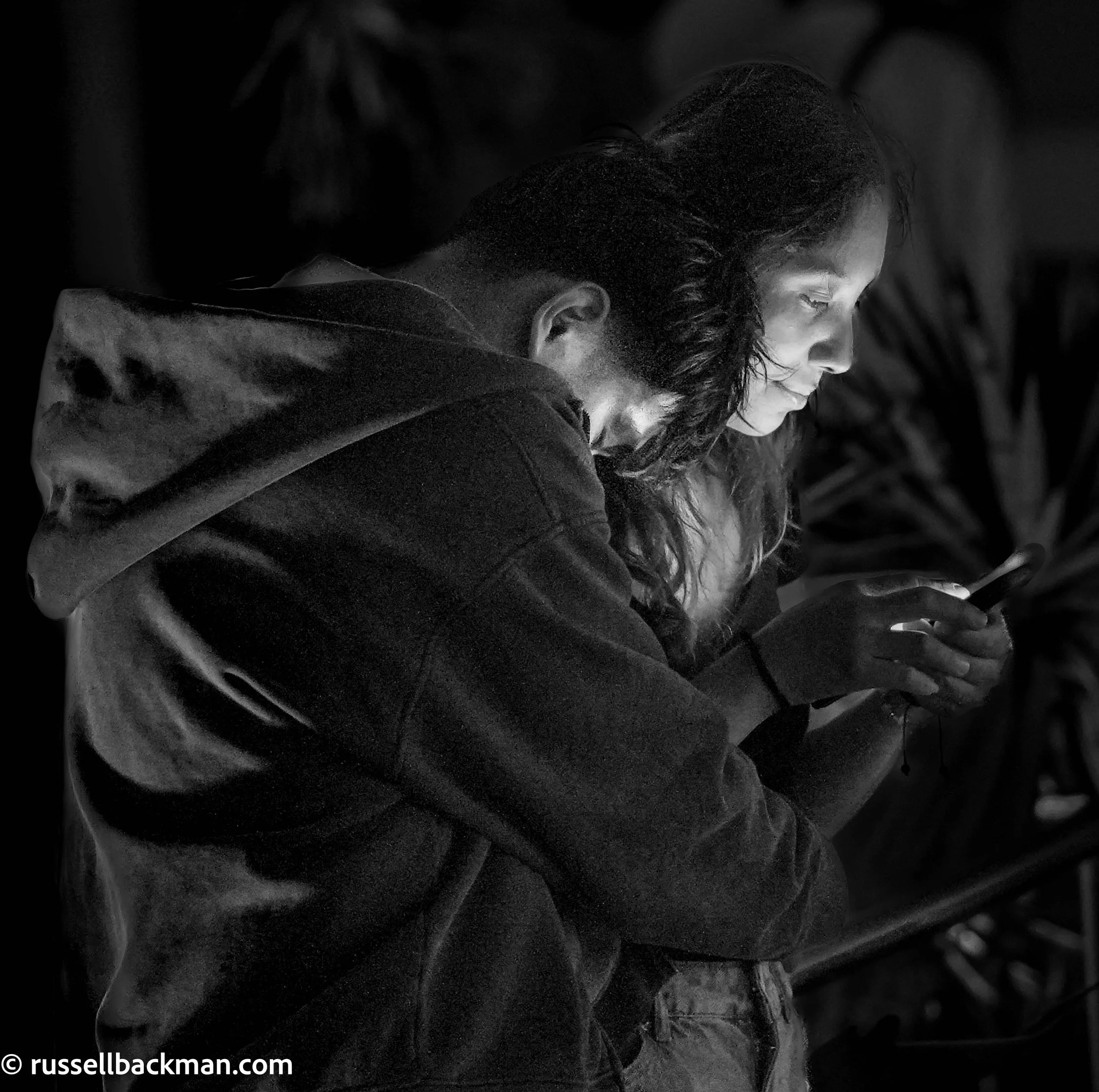
Why Monochrome?
“When you photograph people in color, you photograph their clothes. But when you photograph people in black and white, you photograph their souls.” – Ted Grant
Color is how we see the world, so choosing to strip it away is a deliberate and meaningful act. Black and white street photography has endured for over a century — not out of nostalgia or technical limitation, but because monochrome does something color simply cannot. Here is why so many of the greatest street photographers have reached for it, and why it remains as relevant today as ever.
Monochrome cuts straight to the emotion. Color is distracting. A bright red jacket, a garish shop sign, a patch of green grass — these elements draw the eye away from what actually matters in a street photograph: the expression on a face, the tension in a gesture, the geometry of a moment. Remove color and the viewer has nowhere to hide. They are forced to confront the emotional core of the image directly. Grief looks more like grief. Joy looks more like joy. Black and white has a way of reaching past the surface of a scene and pressing straight on the feeling underneath it.
In color photography, light illuminates. In black and white, light becomes the photograph. Without hue to compete with, the entire tonal range — from the deepest shadow to the brightest highlight — takes center stage. A shaft of sunlight cutting across a dark alley, the soft rim of light around a figure in a doorway, the high contrast of a face half in shade: these become almost sculptural. Black and white rewards photographers who think obsessively about light, and it rewards viewers who learn to read it.
Color dates a photograph almost immediately. The palette of the 1970s looks different from the 1990s, which looks different from today. Black and white lifts an image out of any specific decade and places it somewhere more enduring. A monochrome street photograph taken yesterday can feel as though it belongs to any era — and that ambiguity gives it a strange, lasting power. The great black and white images of Cartier-Bresson or Vivian Maier feel no more "old" than they do "new." They simply feel permanent.
The street is full of graphic possibilities: long shadows stretching across pavement, the repetition of pillars or windows, a lone figure dwarfed by a vast architectural backdrop. Black and white thinking trains you to see these structural elements first, before color pulls you elsewhere. Lines, patterns, silhouettes, and contrast become your vocabulary. Many street photographers describe switching to monochrome as the moment they truly learned to compose — because the image lives or dies by its structure, not its palette.
Street photography was born in black and white. The entire lineage of the form — Brassaï photographing nocturnal Paris, Dorothea Lange documenting the Dust Bowl, Daido Moriyama's grainy Tokyo, Sebastião Salgado's dense, luminous prints — runs through monochrome. Shooting in black and white is not mere imitation of that tradition; it is a conscious decision to participate in a visual conversation that has been going on for over a hundred years. It situates your work in a history and demands that it hold up within that context.
Perhaps most importantly, black and white is harder. You cannot rely on a beautiful sunset or a vivid color contrast to rescue a weak composition. Every image must stand on the strength of its light, its moment, its geometry, and its humanity. This constraint is, paradoxically, liberating. It forces you to slow down, look harder, and think more carefully before you press the shutter. Photographers who commit to black and white often report that it fundamentally changes how they see — even when they pick up a color camera.
Black and white does not make a street photograph more artistic by default. A bad image in monochrome is still a bad image. But when it works — when the light is right, the moment is real, and the tones hold together — it produces something that color rarely can: a photograph that feels less like a record of what was there, and more like the truth of what it felt like to be there.